
- Does a qualified proofreader have to be a native English speaker?
- A qualified proofreader shouldn’t make these mistakes
- What’s the level of education, training, and experience of a “qualified proofreader?”
- A native speaker is more likely to know grammar rules, even if they can’t explain them
- Examine their writing for attention to detail to determine if they’re a qualified proofreader
- Being a qualified proofreader means being consistent
- Learn a couple of often-used (but obscure) grammar rules and look for those errors in their writing
- The joys of English—there’s always an exception
- Dump their copy into Grammarly to help determine if they’re a qualified proofreader
- The post that started it all—definitely not a qualified proofreader
- You should now have more confidence hiring a qualified proofreader
You’ve decided to hire a proofreader. You don’t have the time or patience to ensure your copy is error-free. Noticing typos moments after you hit “send” is getting old. But you’re no grammar expert. How can you assess whether you’re hiring a qualified proofreader?
It’s like choosing the other experts you depend on. You don’t know anything about cars. Thus, you have to trust that the mechanic is qualified, competent, and honest. You don’t have a medical degree. You trust that your doctor is thorough and skilled enough to heal rather than harm you. Reviews, word-of-mouth, and your intuition work sometimes—but there are better ways.
You may be a busy grammarian who doesn’t have time for thorough proofreading. If that’s the case, congratulations! You can likely assess a proofreader’s ability from their resume, cover letter, and website. But if you’re like most people, grammar rules confuse and bore you.

This post will highlight some things to consider when hiring an English proofreader. It’ll help ensure you work with a qualified proofreader.
Does a qualified proofreader have to be a native English speaker?
Non-native English speakers can absolutely reach a high level of English. And there may be a select few who can become qualified proofreaders. But native English speakers need to hire proofreaders. What are the chances a non-native speaker will know the intricacies of English better than a well-trained native speaker?
Non-native speakers can be more knowledgeable of grammar rules than many native speakers. But non-native speakers may struggle to assess nuance or when something “feels” unnatural. As a 25-year EFL professional, non-native English writing jumps off the page at me.

Take this example from a random profile I found on a popular freelancing site.
Hello beautiful people, → This is not a typical greeting a native English speaker would likely use.
“…then you are at the right place…” → The correct preposition is “in.” You are in the right place. Prepositions are notoriously tricky for non-native speakers to get right. There are so many in English, and sometimes you can use different ones, but that changes the meaning. Drop in and drop by are similar, but drop off has a very different meaning.
“I have been helping students in their…..applications since many years…” More preposition issues—you help somebody with a problem. When using since, you need to state a specific point in time, not a period of time. For a period of time, you need to use for.
- I have lived in Korea since 1995.
- I have lived in Korea for 26 years.
A qualified proofreader shouldn’t make these mistakes
All these mistakes (and more) occur in a short introduction of fewer than 100 words. This “proofreader” is making these mistakes in their writing. What are the chances they’d be able to correct your writing accurately?
The worst part of this offer is the “Grammarly premium cleared content” claim. Even the phrasing is awkward. I have Grammarly Premium (affiliate link). When I run their intro through Grammarly, it lights up like a Christmas tree. That means:
- A) This person doesn’t really use Grammarly, or…
- B) This person hasn’t paid for Grammarly premium, or…
- C) This person is too lazy to run their own copy through Grammarly.
Regardless of the reason, there are enough red flags for me to know I do not want to hire this person as a proofreader. They may be a very competent content writer with exceptional organizational skills. But they are not a qualified English proofreader.
What’s the level of education, training, and experience of a “qualified proofreader?”
You’ve determined the person you’re considering is a native speaker. Now, it’s time to consider their education level. I’m sure a few high school dropouts have become qualified proofreaders. But I’m going to assume they are a rare breed.

The higher the level of education, the more likely they are to have a higher level of grammar knowledge. A graduate degree does not guarantee someone is a qualified proofreader. But someone with a master’s degree likely spent a lot of time reading. They may have learned grammar the way most of us do—through reading.
Interesting note: Before I was an EFL teacher, I couldn’t identify a noun, adjective, or verb in a sentence. But in high school and university, I rarely lost points in my essays for poor grammar. I wrote well because I read a lot when I was younger. Like many, I intuitively learned what was grammatically correct. I didn’t learn these basic grammar rules until much later. That happened when I became an EFL teacher and had to explain them to my students.
Like most native English speakers, I intuitively know which prepositions to use. I can’t always explain why certain prepositions are used. But I know that “you are at the right place” is wrong. I know that “I have been helping students in their problems…” is incorrect. It’s something I instinctively know.
I had an interesting discussion with my son a few days ago. We were talking about the difference between the following Korean sentences:
나는 자전거를 타요./내가 자전거를 타요.

The difference in meaning is subtle. I ride a bicycle / I (and not any other person) ride a bicycle. Korean learners have to consciously think about this when they speak. But native Korean speakers don’t. It comes out naturally.
A native speaker is more likely to know grammar rules, even if they can’t explain them
Actually, a native Korean speaker would likely omit the subject altogether. Korean learners (especially native English speakers) struggle with omitting the subject. The subject is necessary in English. What happens when a non-native Korean speaker says the wrong sentence in the wrong context? What if they include the subject unnecessarily? It immediately feels “wrong” to a native Korean speaker.
Ideally, you want someone who actually knows grammar rules. The next best thing is someone who intuitively knows what sounds right. Before becoming an EFL teacher, I couldn’t explain how to use for and since with the present perfect tense. But I would’ve known it was wrong and how to fix it if I’d seen it written in some copy I was asked to proofread.
You can also determine if the person you’re considering has a background in grammar and writing. For example, I was looking at sites for proofreaders and found one for a fellow that seemed qualified. His educational background wasn’t listed anywhere on his site. But he introduced himself as a scientist-turned-writer. He listed several well-known publications he’d written for. One of them was a column for Macmillan Dictionary.
Based on the copy on his site and this information, I’m sure this guy could do a proofreading task for me. Though not stated, being a scientist implies he has a university degree. Writing for Macmillan Dictionary indicates he’s competent. I’d be pretty confident he could deliver top-notch work.
Examine their writing for attention to detail to determine if they’re a qualified proofreader
Many freelance proofreaders have websites or listings on freelance job sites. Earlier, I referenced such a posting from Fiverr, a popular site freelancers use to find work. Whether a native speaker or not, you should examine their page or listing. How well they write can indicate how well they pay attention to detail.
Aside from grammar, spelling, and typos, consistency is an essential thing to look for. If they use section headers, do they consistently use title case or sentence case? Or do they go back and forth? Do all section headings end with a period—or just some of them?
Are they consistent when they write bullet lists or other identifying markers? I examined a site that discussed the difference between proofreading, copyediting, and editing. This is a topic I have also covered. In one section, they used bold phrases to introduce terms, but in the third one, they used a colon. Odd choice.
This lack of attention to detail makes me question if someone’s a qualified proofreader.
Being a qualified proofreader means being consistent
Later on, in a bulleted list, some items were written in sentence case and others in title case. There was no justification for the differences between:
- Blog posts
- Nonfiction books
and…
- Scholarship Essays
- Podcast Notes
In one bullet list, entries started with lowercase letters. Yet they began with capital letters in another.
There are rules for bulleted lists. In almost all cases, bulleted lists should start with a capital letter. There are different rules and situations for using end punctuation. Neither of these lists included end punctuation—but should have. But capitalizing the first word is pretty much a given.
If you look at the bullet lists in this post, you’ll note that all entries start with a capital letter. Some end with a period, and some don’t. That wasn’t random. I did it intentionally. If you want to know why, drop me a message.
You don’t need vast grammar knowledge to determine if a proofreader is qualified. You just need to have a good eye and look for consistency in how they format their writing.
Learn a couple of often-used (but obscure) grammar rules and look for those errors in their writing
Since becoming an English proofreader and copywriter in Korea, I’ve been Googling grammar rules like crazy. I always want to be sure I’m right, and it increases my knowledge of grammar. One thing I’ve been battling with is when to hyphenate words. Learn this rule and look for it in other people’s writing.
Two adjectives should be hyphenated when they appear before a noun. Thus, it is correct to say:
I live in an off-campus apartment. (Off and campus need to be hyphenated for clarity.)
But you shouldn’t use a hyphen when the same adjectives come after the verb.
My apartment is off campus.
Watch for hyphenated words and see if they’re used correctly. If they aren’t, that’s a sign the proofreader either doesn’t know the rules or can’t be bothered to look them up. And you can’t rely on Grammarly for this one.
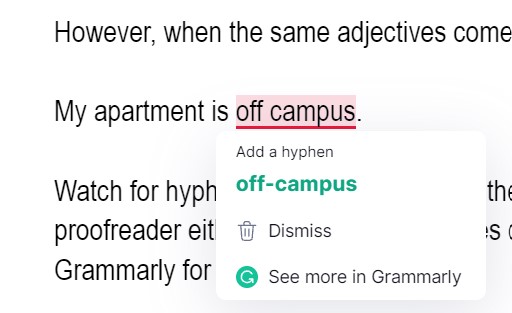
In fact, I recently contacted Grammarly about this issue. Grammarly almost always flags the 2nd example as incorrect. I contacted support about “error-free” being flagged—no matter where it is in the sentence.
The joys of English—there’s always an exception
It was flagged when writing “I guarantee your writing will be error free.” I asked Grammarly to correct this issue. But Grammarly’s team of experts informed me if “free” is the second adjective, it’s always hyphenated.
Thus:
- Error-free
- Sugar-free
- Pollution-free
- Smoke-free
It doesn’t matter where these words appear in the sentence. They need to be hyphenated. I thanked Grammarly support for the grammar lesson—and fixed the incorrect uses of “error free” on my site. Then, I contacted them again. I explained that Grammarly incorrectly suggests adjective phrases should always be hyphenated.
I even pointed them to a post on their own blog that supports my claim. When I paste the blog into Grammarly, the phrases the blog states don’t need hyphens get flagged. Grammarly has informed me they’re examining the issue and will get back to me.

Learn how to use hyphens correctly. Look for it in the work of proofreaders you’re considering. You’ll then have a decent idea of whether they have the attention to detail you want in a proofreader. You can look for other things, but this is pretty straightforward and easy to spot.
You could also learn about the rules for bullet lists I mentioned above. It’s not necessary to become a grammar expert. You just need to know one or two rules really well and look for those errors in other people’s writing. If you spot too many mistakes, that’s a red flag.
Dump their copy into Grammarly to help determine if they’re a qualified proofreader
Grammarly is a tool—and should be used as such. As I just demonstrated, it doesn’t get everything right. But it’s usually a good place to start. Copy the text from a site and paste it into Grammarly (the free version is fine) and see what happens.
Here’s what happens when you put my homepage into Grammarly:
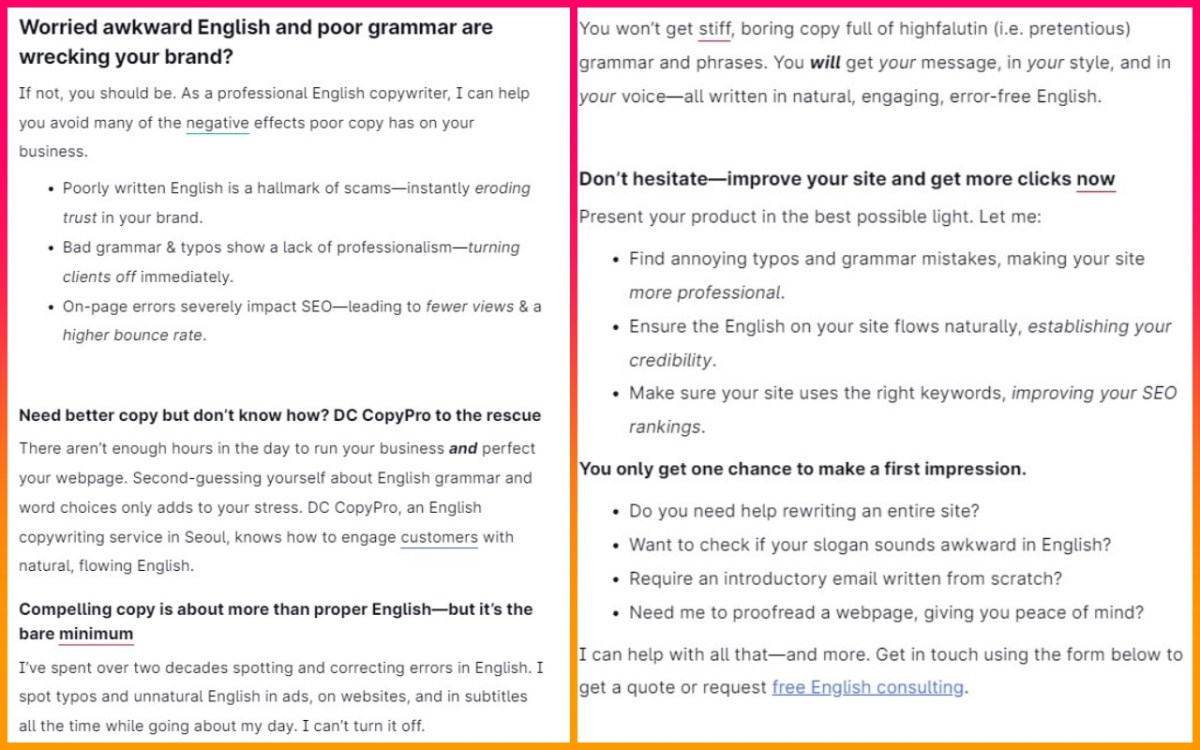
Not perfect, but when you look at the suggestions, it’s not so bad. Grammarly suggests changing negative to adverse. But I feel negative is better for my audience. The two words flagged at the end of two headlines are for missing periods. I don’t use periods at the end of headlines. Grammarly suggests removing customers from one sentence. I feel it’s necessary in this sentence.
Finally, Grammarly doesn’t like copy when used to mean text. It suggests I need to include the article “a” before stiff (a stiff, boring copy). But that’s incorrect in this usage. I’ve gone over this page hundreds of times. I’ve run it through Grammarly, edited it myself, and then run it through Grammarly again. I’m confident it’s grammatically correct and a good first impression of my proofreading ability.
How about the Fiverr text from earlier?
Red means a grammar or spelling mistake. Blue indicates a possible problem with clarity. Green indicates possible issues with engagement, and purple suggests your delivery is off. Someone offering “Grammarly premium cleared content” should start with their own writing.
The post that started it all—definitely not a qualified proofreader
After coming across this article on a proofreading site, I decided to write this post. This person was passing themself off as a qualified proofreader. But there were three errors in the first sentence! Not to mention, the blog was center-aligned, not aligned left. Only a madman/madwoman would do that. 😉
Most of the errors are related to incomplete sentences and improper comma use. But there are other glaring errors. For example, “…ensure your texts do not…” This was not a sentence about text messages. It was about the text (or copy) on your page. In that usage, it should never be plural.
I was actually offended that this person calls themselves a proofreader. I fully admit that some grammar rules are open to interpretation. You can follow different style guides (MLA, Chicago Manual of Style, etc.). There’s not always a “right answer.” You can make arguments for and against the Oxford comma.
But writing, “Let’s face it, it’s no longer a secret, …” is wrong no matter how you slice it. This person has no business masquerading as a proofreader. That should be written as two sentences or with a semi-colon instead of a comma.
Here’s what the proofreader’s post looked like in Grammarly.
There are far more errors here than there should be on a page for someone professing to be a proofreader.
You should now have more confidence hiring a qualified proofreader
Do you remember the guy I suggested would make a great proofreader? The scientist who wrote articles for a major dictionary? I ran his site through Grammarly. There were more suggestions than I’d anticipated. Many of the flagged suggestions were just that—suggestions similar to the ones on my site. But there were also errors with comma usage. I’d have to reconsider using this guy as a proofreader.
I’ve joked that it’s something I live in fear of—people finding typos in my writing. I’ve outlined how thoroughly I proofread and review all my writing. But the occasional error still slips through. No one’s perfect—not even me! 😉
I’ve gone back over blog posts I haven’t read for a while and spotted embarrassing typos. My friends/readers delight in catching one of my missed typos. Such is the existence of a self-professed proofreader.

If you’re going to hire a proofreader, you want them to be qualified and make changes that improve your writing. If you don’t feel confident about your own writing, it can be challenging to determine who’s qualified and who’s not. But after reading this post, you’re now better equipped to assess the abilities of a proofreader. That’s even if you’re not sure about grammar rules yourself.
Do you feel better equipped (or is it better-equipped? 😉 ) to judge the ability of proofreaders you’re considering hiring? Or do you still feel completely lost? Let me know in the comments.
Subscribe to this blog or follow me on Instagram, Threads, Facebook, LinkedIn, or Twitter for more content and updates.