
- Well-written, clear regulations cause less confusion, not more
- Awkward English in Korea—Page 1—Off to a flying start
- They need to make several other random fixes
- Awkward English in Korea—Page 2—I wish I could say it gets better—but it doesn’t
- You can’t just split words in English any way you like
- Awkward English in Korea—Page 3A—Too much information and too many errors
- Awkward English in Korea—Page 3B—The end is in sight, but there is no end to the madness
- Awkward English in Korea—Page 4—Hang in there—one more split page to go
- Awkward English in Korea—Page 4B—Finally, we’ve reached the end…of the guidelines, but not the errors
- If the government had been one of my students, I would’ve passed them…but barely
Well-written, clear regulations cause less confusion, not more
As of posting, we’ll have just started our 2nd two-week stint of the new Level 4 social distancing measures in Seoul. Korea has set several records this past week for the daily number of COVID-19 cases. It is unlikely we will relax social distancing measures anytime soon.
The purpose of this post is not to debate the effectiveness or logic of these Level 4 measures. It will examine the awkward English in the Korean government announcement. This awkward English comes in the form of grammar errors, vocabulary, and formatting. I acknowledge they put these measures in place hastily. But officials decided on them well in advance of publishing them on July 12th, 2021.

The government should serve as an example to the nation. But if this is the example being set, it is no wonder a proliferation of poor and awkward English in Korea abounds. From street signs to business signs, menus to clothing, awkward, error-filled English is everywhere. The extensive examples on my Instagram feed (new posts daily) are evidence of this.
This post will examine Korea’s four-page English social distancing measures. It will point out several mistakes, but the scope of this blog does not allow me to correct every error. That would not be possible without a complete rewrite of the material. I will point out the most egregious errors and suggest fixes.
Awkward English in Korea—Page 1—Off to a flying start
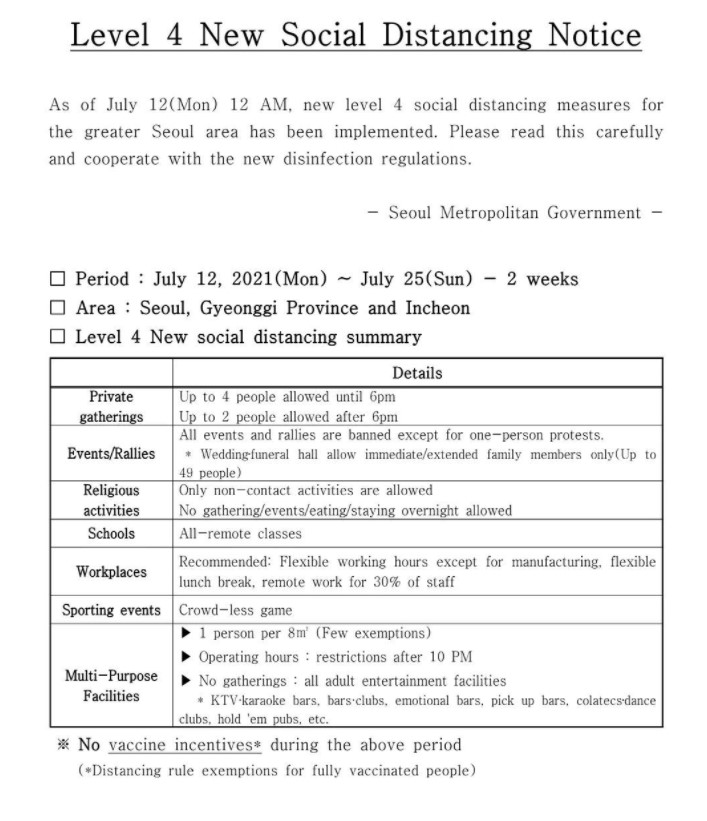
It’s never a great start when your opening statement has multiple errors.
As of July 12 (Mon) 12 AM, new level 4 social distancing measures for the greater Seoul area has been implemented. Please read this carefully and cooperate with the new disinfection regulations.
Oof! Though the meaning is pretty clear, it doesn’t flow. Let’s try to make this a little more natural.
As of 12:00 am on Monday, July 12, new Level 4 social distancing measures for the greater Seoul area have been implemented. Please read them carefully and abide by the new disinfection regulations.
Or, they could’ve gone with:
New Level 4 social distancing measures for the greater Seoul area go into effect at 12:00 am on Monday, July 12. Please carefully read and follow these guidelines.
Other notable problems:
- There is no consistency with the use of AM/am and PM/pm. It’s acceptable to write both ways. But you need to pick one format and stay with it (6 pm / 10 AM).
- Abbreviations end with a period (Mon → Mon.).
- Place spaces before and after opening and closing brackets (no sign of that here).
They need to make several other random fixes
- In English, we place a space after a colon but not before one (Period : → Period: / Area : → Area: )
- Clarity → Wedding and funeral halls can permit up to 49 immediate/extended family members.
- All-remote → This is not a word. “All remote classes.”
- flexible lunch break → flexible lunch breaks
- Crowd-less (not a word) → No spectators
- Few exemptions → Few exceptions

And for those wondering about the multitude of adult entertainment facilities:
- KTV bars → Karaoke television bars
- Emotional bars (감성주점)—Bars for people in their 20s to sing, dance, and meet new people (somewhere between a club and a pub, similar to a typical western bar).
- Pick-up bars → Isn’t this most bars? But the term ‘pick-up bar’ seems too informal for a government memo.
- Colatecs → Portmanteau of cola & discotheque (possible Konglish term) → Daytime dance clubs for older folks.
- Hold’em pubs → Bars for playing cards, especially poker.
Finally, the last two lines are somewhat confusing. First, it states there will be no incentives for vaccinated people during this period. But the following line then states there are exceptions for weddings and funerals. This seems to imply that the distancing rules don’t apply to fully vaccinated people. Is that not the very definition of an exception?
Okay, that’s page one…of four. I can’t give the same attention to the following four pages. This blog would turn into a thesis-length diatribe. I’d prefer to avoid that.
Awkward English in Korea—Page 2—I wish I could say it gets better—but it doesn’t
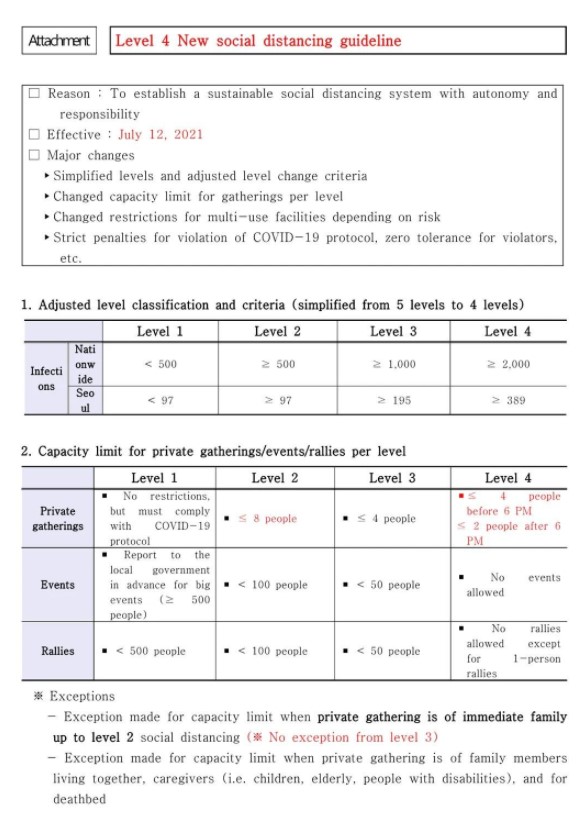
From here on in, I’ll try to limit my comments to new and egregious mistakes.
Let’s start with the use of red. Its use isn’t explicitly explained. It appears to indicate changes to the previous system/guidelines. There were five levels (Levels 0.5, 1, 1.5, 2, 2.5—clear as mud), but now there are four.
These new guidelines went into effect on July 12, 2021. I assume restrictions on private gatherings in red are new compared to the old system. But without expressly stating this, it’s confusing.
Other than that, what’s my beef with page 2? Let’s start with the last line of the section in the top box.
Strict penalties for violation of COVID-19 protocols, zero tolerance for violators, etc.
What does ‘etc.’ mean here? Are you not supposed to be setting clear guidelines to follow? Using ‘etc.’ leaves a lot open to interpretation.
You can’t just split words in English any way you like
My next major beef here concerns formatting. Let’s look at the row headings in the first column:
Infecti
ons
Nati
on w
ide
Seo
ul
You can’t write English like that. You should write it like this:
Infections
Nationwide
Seoul
There are strict rules about how to split words in English. The first rule is that you can only split words between syllables. The second rule is that you must use a hyphen. Neither of these rules is in effect here. Resizing the chart would’ve been the most effective means of resolving this problem. If necessary, they could’ve used a different font.
The exceptions (not exemptions, which was the term used on page one) are confusing.
Exception made for capacity limit → Exceptions made to capacity limit…
The use of bold is odd here. I’m not sure what it’s emphasizing.
There are other awkward phrases here:
- When private gathering is of → When private gatherings consist of
- Elderly → seniors, the elderly
- And for deathbed → and for family members on their deathbed
- Perhaps a more natural version would read something like:
- The limits on private gatherings do not apply to family members living together, including those providing care to children, seniors, or those requiring assistance. Nor does the limit apply to those caring for those on their deathbed.
Awkward English in Korea—Page 3A—Too much information and too many errors
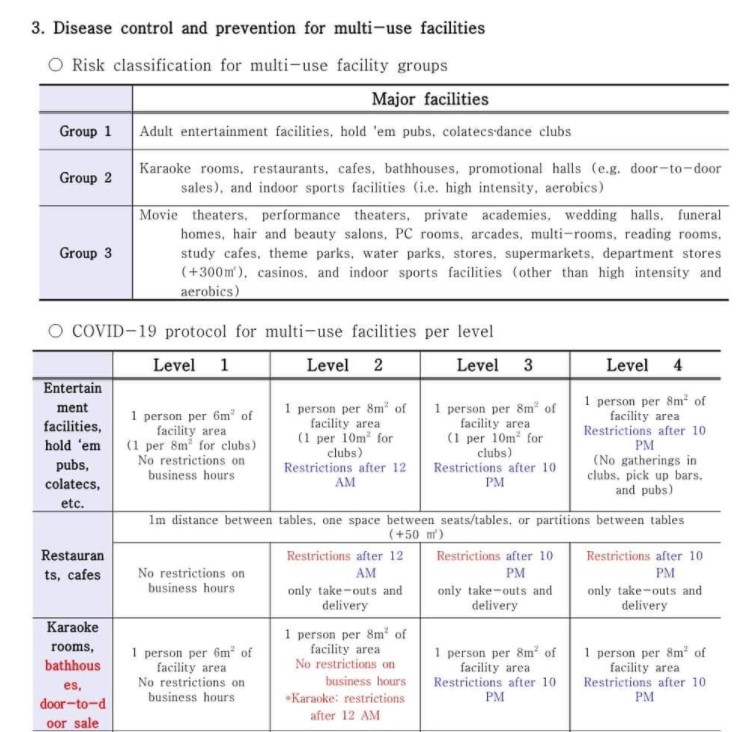
Again, it is not my intention to try to make sense of these regulations—other than from a linguistic point of view. I shall not be commenting on the difference between high-intensity and low-intensity exercise. Authorities have defined high-intensity exercise as
- Over 6 km/h for treadmills.
- Over 120 bpm for music in aerobic classes.
I’ll leave it up to you to debate these limits.
Linguistically (and logically), I am perplexed by the phrase in Group 2:
…promotional halls (e.g. door-to-door sales)
Say what now? Are promotional halls not the exact opposite of door-to-door sales? I also struggle to understand how you can classify ‘door-to-door sales’ as a multi-use facility.
Another minor irritation:
Multi-rooms → Multi-use rooms
Again, the splitting of words is unacceptable here. It would look 100x better if the time and the following abbreviation appeared on the same line:
12 am / 10 pm
- The phrase “One space between seats/table” could be better expressed as “Seating at alternating tables.”
- ‘Take out’ cannot be plural. Only take-outs → Only take-out.
- The restrictions are not defined. Does it mean, “Must close by…”?
Let’s return to the use of red text. Restaurants have been closing at 10 pm for months in Seoul. This is not new, but it’s listed in red in this section. Why?
Awkward English in Korea—Page 3B—The end is in sight, but there is no end to the madness
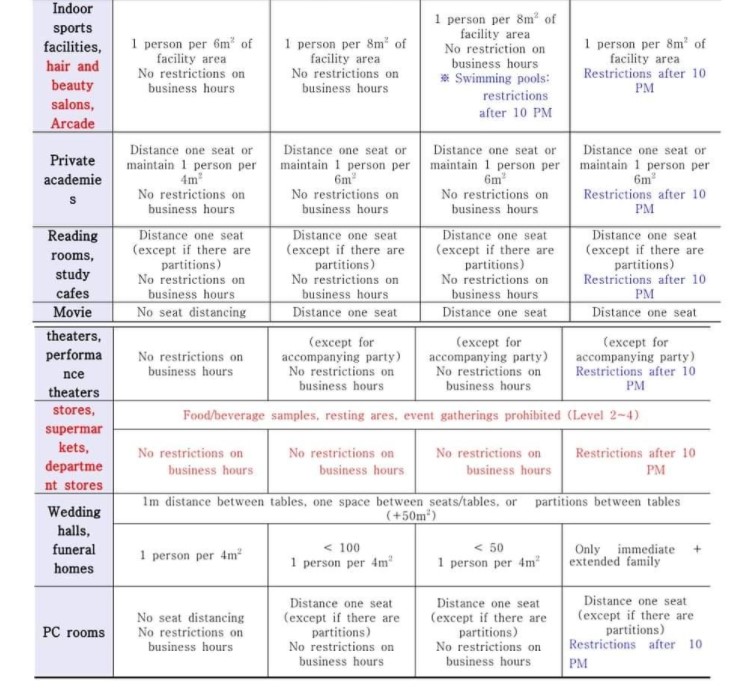
The regulations for private academies and movie theaters are awkward:
Distance one seat → Empty seats between students/patrons
Under “theaters, performance theaters” (inexplicably uncapitalized), what does “Except for accompanying party “ mean? Any suggestions? Leave ‘em in the comments below.
We also have a genuine typo in the top line. “Stores, supermarkets, department stores (again, no capitalization): resting ares” → resting areas,
Finally, in several cells in this table, there is odd spacing. There are several instances of extra spaces. It seems like the cells have been both centered and justified—an odd choice.
Awkward English in Korea—Page 4—Hang in there—one more split page to go
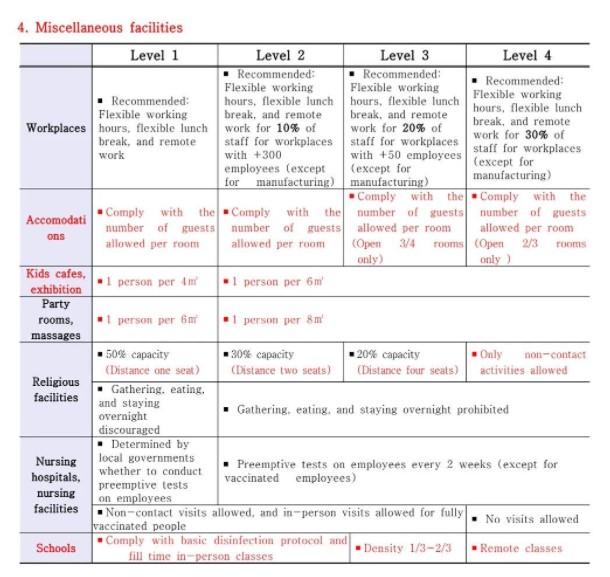
Not much new here. Again, more odd spacing, improperly split words, and general awkwardness.
One of the first things we learn about writing sentences is that each sentence should be about one topic. We also learn that “and” joins similar ideas, whereas “but” shows a difference. Under nursing hospitals, nursing facilities, it reads:
Non-contact visits allowed, and in-person visits allowed for fully vaccinated people.
It should probably read:
Non-contact visits allowed. In-person visits allowed for fully vaccinated people.
OR
Non-contact visits are allowed, but fully vaccinated people are permitted to have in-person visits.
Finally, under “Schools,” it would appear we have another typo:
Fill time in-person classes → full-time in-person classes
Awkward English in Korea—Page 4B—Finally, we’ve reached the end…of the guidelines, but not the errors
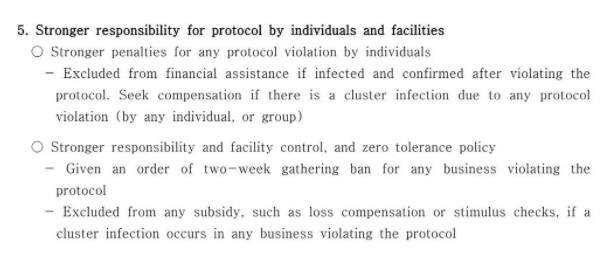
In this final section, again, we have some unclear, awkward phrases. I believe “Seek compensation…” should be written as “Liable for compensation…” And since one period has been used, it is necessary to end all these sentences with periods.
Again, it would be more natural to separate the ideas in the second point and write it as:
Stronger responsibility for individuals and establishments. Zero tolerance policy for non-compliance.
Finally, the final two sub-points would read more naturally if they were written:
Any business violating protocols will receive a two-week gathering ban.
Businesses will be excluded from any subsidies, such as loss of compensation or stimulus checks, if a cluster infection occurs at any business found in violation of the protocol.
If the government had been one of my students, I would’ve passed them…but barely

It is painfully apparent a native English-speaking translator or proofreader was not consulted. The sheer number of errors and the types of errors is unacceptable. Remember my motto: If it’s worth doing, it’s worth doing right.
Returning to how I opened this post—the government should be setting an example for the nation. Suppose citizens regularly see poorly formatted, error-laden text like this from their own government. What motivation do they have to try and get the English on their storefronts and menus correct?
Well, even if the Korean government isn’t interested in encouraging the use of proper English, I am.
For any Koreans reading this post…
If you want to be professional and use proper English on your signs, in your advertising, and with your online presence—contact me for help. If it’s a simple job, you may even be able to get help for FREE. That’s how badly I want to see an improvement in the quality of English used in Korea.
Subscribe to this blog or follow me on Instagram, Threads, Facebook, LinkedIn, or Twitter for more content and updates.