
- How do you get people to open your emails? Simple—subject lines
- For what other reasons was this email flagged as spam?
- One mistake on its own wouldn’t be a problem—but several can get your email flagged as spam
- Our second example is better, but it’s another email flagged as spam
- A good friend shared this last example with me
- Here’s a pro tip for your emails
- You have to do so much right to succeed
On my homepage, I warn that poor English may get your email flagged as spam. It’s a hallmark of scams. Check out these articles from Snopes that cite poor grammar as a classic sign of a scam.
- McDonald’s Email Scam Claims ‘You Have Been Selected’
- Is the ‘Jeff Green Foundation’ Email Giveaway a Scam or Legit?
- ‘USPS’ Text Message Scam Claims Delivery Problem, Asks for Personal Financial Info
I pay special attention to this concept as an English copywriter and proofreader. I constantly evaluate writing—it’s a (former) occupational hazard. Most people just delete unwanted emails—I examine them. I’m going to share some of what I’ve observed.
If you’re writing to someone you have a relationship with, the occasional error isn’t such a big deal. But it’s a different story if you’re contacting someone for the first time.
Cold emailing is when you email someone who isn’t expecting to hear from you. To succeed with a cold email, you must make a great first impression. An email riddled with mistakes will decrease your chances of success.
Writing cold emails that people read is challenging—even for an experienced English copywriter. It doesn’t matter if the person you’re contacting could benefit from your product or service. If they don’t open your email, you’ll never be able to sell them your product or service.
How do you get people to open your emails? Simple—subject lines
Your subject line has to create enough interest or curiosity to get the reader to open the email. If it doesn’t—trash folder! Even worse, your email could get added to the recipient’s spam filter. Once that happens, none of your future emails will get through.
Can you see what’s wrong with this first email in my spam folder? Gmail kindly flagged it as spam for me.
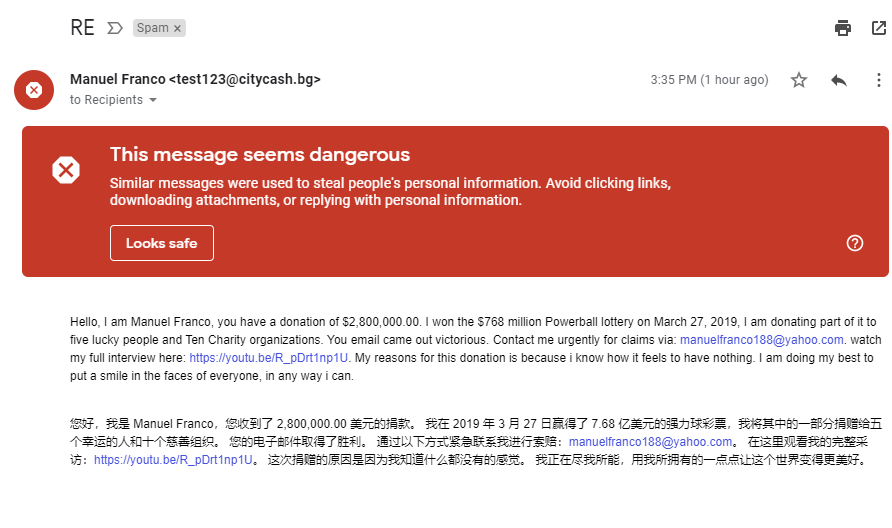
The first warning sign is that there’s no subject line. Well, actually, there is—RE. Of course, this appears when replying to an email. But if you ever send emails with blank subject lines (never do that), this is a warning sign of a potential scam. It’ll likely get your email flagged as spam.
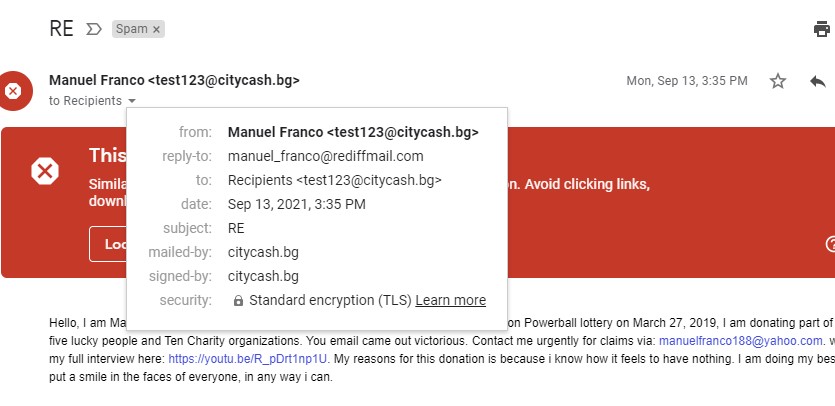
For what other reasons was this email flagged as spam?
The country code .bg is for Bulgaria, but Manuel Franco wrote this email. It’s possible someone of Spanish descent lives and works in Bulgaria. If that were the only inconsistency, it wouldn’t have registered as a red flag for me.
Let’s look at the email a little closer. The username of the email is “test123”—that seems legit. When teaching, I always told my students to use a professional email address for business. “hawtgurlz@warmmail.com” won’t cut it.
But the email address provided in the email body differs from the one in the header—another red flag. Looking at the header info, there’s yet another email address—rediffmail.com. Would it surprise you to know that Rediffmail is an Indian email company? Nothing suspicious here at all!
Furthermore, this email is one paragraph. Emails have a structure:
- A greeting (or salutation)
- A body
- A closing
- The sender’s name
One mistake on its own wouldn’t be a problem—but several can get your email flagged as spam
This is a paragraph with poor grammar, punctuation, and capitalization. Oh, and let’s not overlook the helpful CHINESE translation!
- A Spanish name
- An American lottery
- A Bulgarian email address
- An Indian email service
- An email written in English and Chinese
Sorry, but you deserve what’s coming if you didn’t recognize this as a scam!
Manuel Franco did win the Powerball jackpot back in 2019. The YouTube link is about the only legitimate thing in the email. But I have serious doubts Manuel sent his email. 😉
Our second example is better, but it’s another email flagged as spam
The following email has a subject line, but it’s still problematic. When used to congratulate someone, the correct expression is “Congratulations.”
This subject line doesn’t give much information about what’s inside. But we all love winning stuff, right? It might be enough to get you to open this email. After all, people have been opening Publisher’s Clearinghouse Sweepstakes for decades!
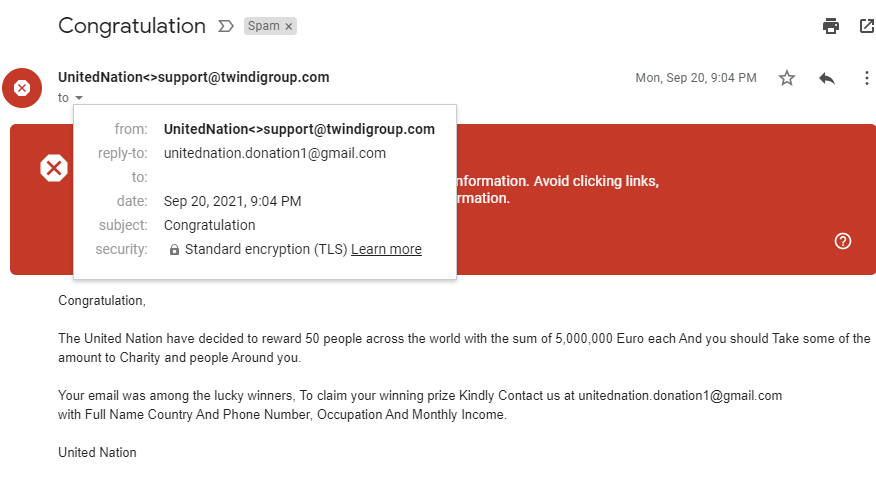
Let’s look at the email address again—I should say email addresses. Notice the from address and reply-to address are different? That’s rarely a good sign. Especially when the misspelled United Nations (United Nation—there’s more than one nation in the UN). Furthermore, the Twindi Group is an eCommerce business located in Bahrain.
This example looks more like email should look. It has a salutation, though “Congratulation” isn’t a standard salutation. It has a body, but randomly capitalized words and missing punctuation aren’t a good sign. There is no closing (i.e. Regards, Sincerely,) and ends with “United Nation.” Representatives of organizations send emails—not the organization itself.
To any native-English speaker, the poor formatting, grammar, and capitalization set off alarm bells.
A good friend shared this last example with me
My friend received this email with a kind offer to help with website design.
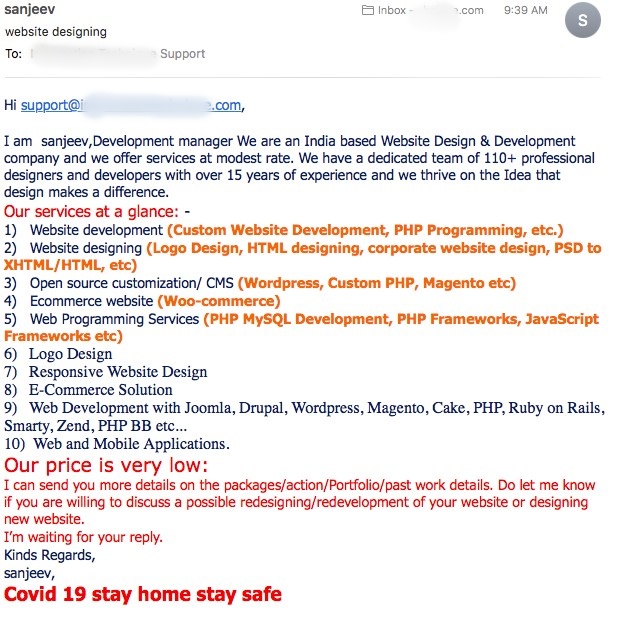
I don’t know about you, but this email looks like an 8-year-old wrote it. In the late 1980s. Using a computer for the first time. Who’d just figured out how to use fonts of different sizes and colors. Oof!
Let’s start with the salutation. It’s no secret that marketers collect email addresses and personal information. It happens when you sign up for a newsletter, register for a site, or fill out a form. They then use that information to send out “personalized” emails.
Well, only if they’ve set up their email programs correctly. It’s pretty poor form to open your email with:
Dear email@address.com,
I’m not sure what it says about Sanjeev that he doesn’t feel his name is worthy of capitalization. Yet, he chooses to capitalize common nouns like Development, We, and Website.
Here’s a pro tip for your emails
If you’re going to claim your “price is very low,” you should include the price in the email. At least include a line like, “Packages starting from $65.”
People love a good mystery. They also have lots of time to reply to emails for clarification, seeking information that should’ve been in the original email. (The Internet needs a sarcasm font.)
Email campaigns can be very effective—even cold emailing. Once you’ve collected email addresses (hopefully ethically), sending emails is free.
You’ve likely collected email addresses from people interested in your product/service. They signed up for your website or newsletter or requested more information. You should have an audience that has at least some interest in your product/service.
But open rates are declining. Looking at some online stats, open rates for cold emails have dropped from 22.15 % in 2019 to 18% in 2020.
If the recipient opens your email, don’t blow it! Eliminate mistakes to increase the chances you’ll hear back from the person you’ve contacted.
You have to do so much right to succeed
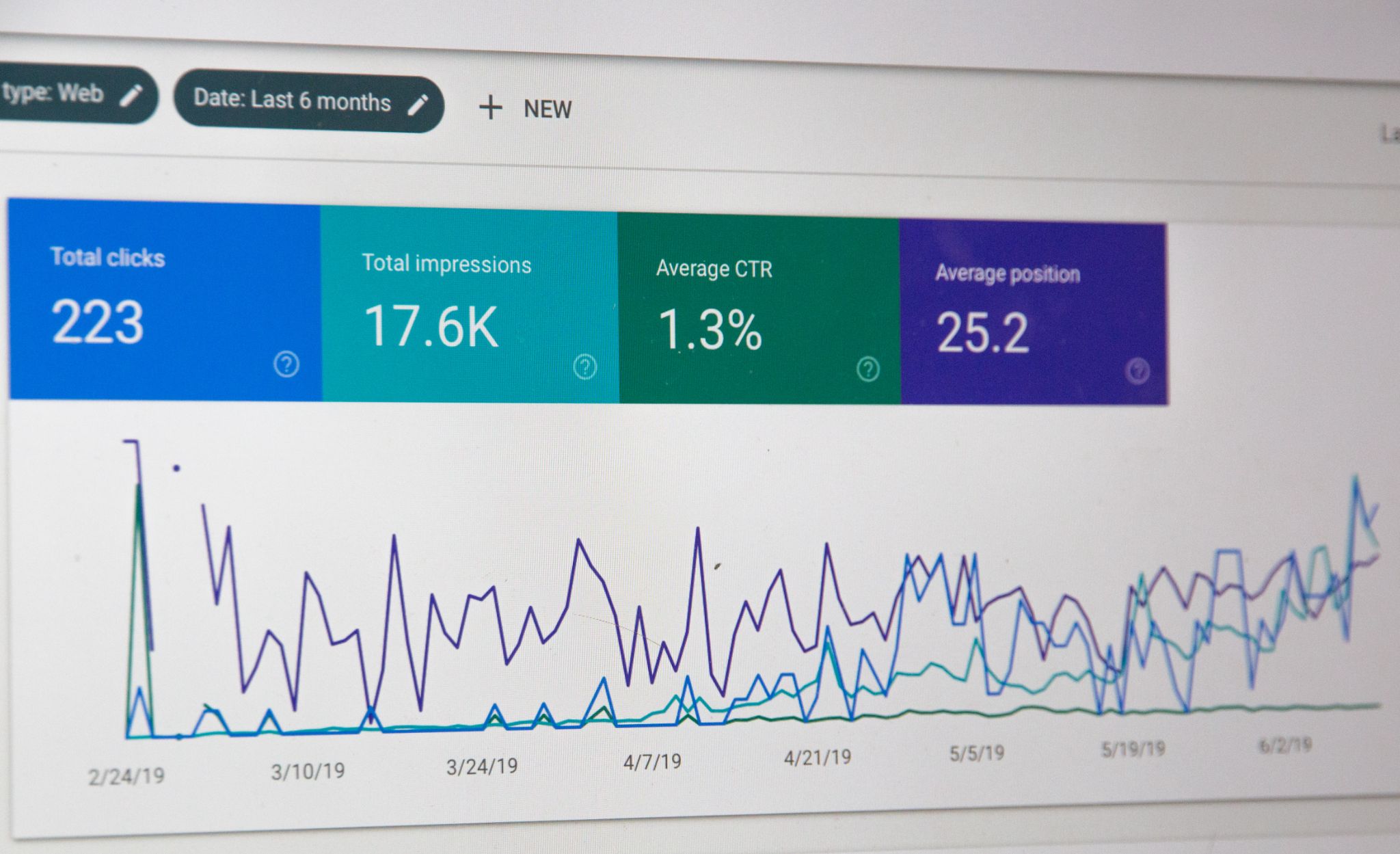
With a mere 2.6% click-through rate (CTR), it doesn’t take much to fail. Even well-crafted emails written by experienced English copywriters struggle to get results.
On average, they don’t convert—97.4% of the time. But every mistake in your email moves the reader closer to hitting “delete”—or “mark as spam.”
Give yourself the best chance of success. Start by reviewing my tips for writing an effective business email:
- Use a professional email address
- Write a meaningful subject line that makes the reader want to open your email
- Start your emails with a salutation and end them with a proper closing
- Eliminate most (if not all) of the errors in your emails
- Make sure your email sounds natural and that it flows
Follow these steps to increase your email campaign’s chance of success. Avoid poor grammar, use punctuation correctly, and follow capitalization rules. Making these mistakes increases the chances of getting your email flagged as spam. When that happens, no one will read them before they’re deleted.
If you need help writing business emails or giving your email campaign the best chance of success, contact DC CopyPro. I got you to click on this post and read it to the end, didn’t I? As an English copywriter in Korea, I can help you write subject lines that get opened and emails that convert.
Comment below to get the help you need.
Subscribe to this blog or follow me on Instagram, Threads, Facebook, LinkedIn, or Twitter for more content and updates.