
- English number prefixes—an animal by any other name
- Marriage and relationships are never easy
- If I could save time in a bottle, it would be with English number prefixes
- I’m dating a really hot vicenarian. Really? What planet are they from?
- Why are numbers so complicated?
- If only Korean had number prefixes like in English
- Do English number prefixes help with large numbers? Darn tootin’ they do!
- Finally, how to read that number!
Last week I promised to teach you how to read this wild, long number in English. And I will—but you’ll need to learn some English number prefixes to do that.
987,654,321,012,345,678,909,876,543,210,123,456
I promise, by the end of this post, you’ll be able to read that number in English. But first, I want to give more examples of words that use English number prefixes. Then I’ll look at why Koreans tend to struggle with large numbers in English. While doing so, I’ll teach you how to count to 999 in Korean. And I’m going to do that by teaching you a grand total of 11 words! Don’t believe me? Keep reading!
Last week, I shared words with number prefixes related to math, music, sports, and language. I’m going to provide a few more examples this week. This time, we’ll look at words related to animals, relationships, time, and age.
English number prefixes—an animal by any other name
The animal you’ve probably already guessed that fits into this category is the octopus. How many tentacles does an octopus have? That’s right! Eight. Coincidence? I think not! Two insects that you may have guessed fit this category are a bit confusing.

You could be forgiven for believing that centipedes all have 100 legs. They can actually have anywhere from 30–354 legs. It seems unlikely that a millipede has 1,000 legs—and they usually don’t. They often have 34–400 (more than a centipede), though one species does have over 1,300 legs.
And though it is a mythical creature, how many horns does a unicorn have? By now, I don’t need to tell you that they have a single horn. Long extinct, I bet you can guess how many horns a triceratops had. Yup, three! Lots of English number prefixes in the animal kingdom, too!
Marriage and relationships are never easy
Some people believe there’s only one true love for each person. Whether you believe that or not, the most common form of marriage is a monogamous marriage. As the name implies, monogamy means one partner—either for life or at one time.

Some people don’t agree with this arrangement and prefer to have more than one partner or spouse. These types of relationships are referred to as polygamous (many). In many countries, polygamy is illegal—but not everywhere.
A related concept is a polyamorous relationship. This is where one or both partners have relationships (often sexual) with others. Of course, if you’re in a polyamorous relationship but your partner doesn’t know—well, that’s called cheating. 😉
While bigamy may seem like a good thing (we know bi means 2), it isn’t. It’s related to the number two, but it means being married to two people simultaneously. In a monogamous society where polyamory is illegal, bigamy is also unlawful.
If you get married again after a divorce or the death of a spouse, we usually say you got remarried (married again). But this situation can also be referred to as digamy (meaning second marriage). But just calling it your second marriage will draw far fewer confused looks.
If I could save time in a bottle, it would be with English number prefixes
You may be familiar with periods of time that use English number prefixes. What’s a period of ten years? A decade. And 100 years? A century. Are you old enough to remember Y2K? Remember how there was concern the world would end in the new millennium—1,000 years?

Yes, when the years changed from 1,XXX to 2,XXX, we entered a new millennium. There was concern that computers, which had only been designed to handle years starting with 1,XXX, would go from 1999 and reset to 1000. It didn’t happen. Nothing happened—well, nothing like what people feared. We survived.
But we don’t only measure periods of time with English number prefixes. You likely use four words you never realized have roots in these number prefixes. I’m referring to the last four months of the year:
- September
- October
- November
- December
But wait a minute! September isn’t the seventh month—it’s the ninth month. The same goes for the other three—they’re all two numbers off. What gives?
To keep things short, there used to be ten months in a year. At that time, September was the seventh month, and the other three months matched up. The months before September were called Quintilis and Sextilis—anything look familiar?

There’s a misconception about July and August being added. People believe they were added to honor Julius Caesar and Augustus Caesar. Actually, January and February were the months added to the Julian calendar. That was created under Julius Caesar’s rule. Quintilis and Sextilis were the months renamed in honor of the Roman rulers.
So, September, October, November, and December used to be the 7th, 8th, 9th, and 10th months. Now you know why those names don’t make sense.
I’m dating a really hot vicenarian. Really? What planet are they from?
The last group of words I will teach you is more about trivia. Many aren’t commonly used, but since we already know the number prefixes, why not learn a few more words?
- denarian: a person in their teens (10–19)
- vicenarian: a person in their twenties (20–29)
- tricenarian: a person in their thirties (30–39)
- quadragenarian: a person in their forties (40–49)
- quinquagenarian: a person in their fifties (50–59)
- sexagenarian: a person in their sixties (60–69)
- septuagenarian: a person in their seventies (70–79)
- octogenarian: a person in their eighties (80–89)
- nonagenarian: a person in their nineties (90–99)
- centenarian: a person between 100–109 years old
- supercentenarian: a person +110 years old
I would advise against referring to yourself as a tricenarian. Just say, “I’m in my thirties.” BTW, you may be confused by the word for someone in their twenties. That’s because the prefix comes from the Latin word for twenty.
The most common usage of these words seems to be in newspapers and TV news—particularly for people over 60. News hosts seem to enjoy mentioning septuagenarians who’ve finished marathons. They like talking about the supercentenarian who still drinks a glass of wine every day. I think people just like saying the word supercentenarian.

As I often told my students, these aren’t words you need to use. But it’s nice to know them, and since you know the number prefixes, they require no extra effort on your part. The next time you hear a news report about an octogenarian, you’ll know what it means. You’ll know they’re talking about someone in their 80s—not some creature with eight legs.
Why are numbers so complicated?
Learning to count in English is no small feat. Sure, it’s easy enough to count from one to ten. But then you have to learn nine new numbers for the teens (eleven, twelve,…nineteen). Then you need to learn yet another word—twenty. And after 29, you need to learn thirty, and so on. What if there were an easier way?
There is! It just isn’t English. It’s Korean. In Korean, once you learn to count to 10, you can immediately count to 99—with a bit of practice.
- 1—il
- 2—i
- 3—sam
- 4—sa
- 5—oh
- 6—yuk
- 7—chil
- 8—pal
- 9—gu
- 10—ship
So what do you do when you get to 11? You do what comes naturally! What is 11? It’s just ten and one, right? Ship-il! It couldn’t be easier! What about 20? Again, a piece of cake! Twenty is just two 10s. I-ship! Thirty? Sam-ship? Ninety? Gu-ship! Easy, isn’t it?

When we get to 100, we need to learn one more word—baek. And with those 11 words, you can figure out how to read numbers up to 999 in Korean!
- 123—baek (one-hundred) i-ship (twenty) sam (three)—no need to say “one” hundred (il-baek). Just use baek.
- 654—yuk-baek (six hundred) oh-ship (fifty) sa (four)
- 709—chil-baek (seven hundred) gu (nine)
Of course, it’ll take a little practice, but those 11 words are all it takes. Learning two more words, cheon (1,000) and man (ten thousand), allow you to read numbers up to 99,999. But after that, it gets a bit confusing.
If only Korean had number prefixes like in English
Unlike in English, large Korean numbers are grouped in sets of four. Groupings of four don’t align well with the commas used every three digits in English numbers.
- 10,000—man (ten thousand)
- 100,000—ship-man (10 ten thousands)
- 1,000,000—baek-man (100 ten thousands)
- 10,000,000—cheon-man (1000 ten thousands)
- 100,000,000—eok (one hundred million)

And then the pattern repeats:
- 1,000,000,000—ship-eok (10 one hundred thousands)
- 10,000,000,000—baek-eok (100 one hundred thousands)
- 100,000,000,000—cheon-eok (1000 one hundred thousands)
Notice we use the “new word” (i.e. man or eok—FYI, the word for one trillion is jo) and then add 10, 100, or 1000 in front of it. Those groups of four and numbers grouped in threes don’t play nice together.
That’s why when Koreans encounter large numbers, they must count the number places (tens, hundreds, thousands, ten thousands, etc.). But in English, all we have to do is count the commas. For Koreans to identify the number 8,000,000,000,000, they must count 13 places. English speakers only need to count four commas.
Interesting cultural note—watch Koreans’ fingers and mouths when they encounter large numbers. It’s pretty common for them to count the places with a finger [ship (tens), baek (hundreds), cheon (thousands), etc.]. It’s also not uncommon for them to quietly say the words—or at least mouth them as they go.
Do English number prefixes help with large numbers? Darn tootin’ they do!
Starting from the right, in English, we read the commas as:
Thousand, million, billion, trillion, quadrillion, quintillion, sextillion, septillion, octillion, nonillion, decillion. Perhaps it will make a little more sense when displayed like this:
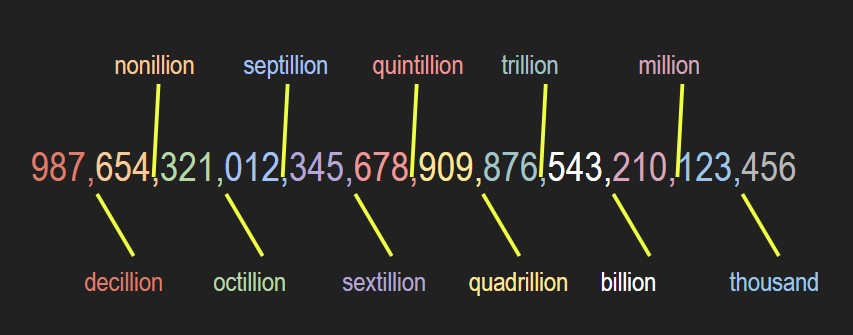
We can go on, but the chances you’ll use those numbers are exponentially unlikely. You probably only need to know the first four: thousand, million, billion, and trillion. Numbers larger than that are generally written in scientific notation (## x 10XX). But if you want to read this number, you need to count 11 commas. A Korean needs to count 36 places.
Finally, how to read that number!
No more games or teasing. It’s time to read that number. Here it is, but be warned—it’s a mouthful!
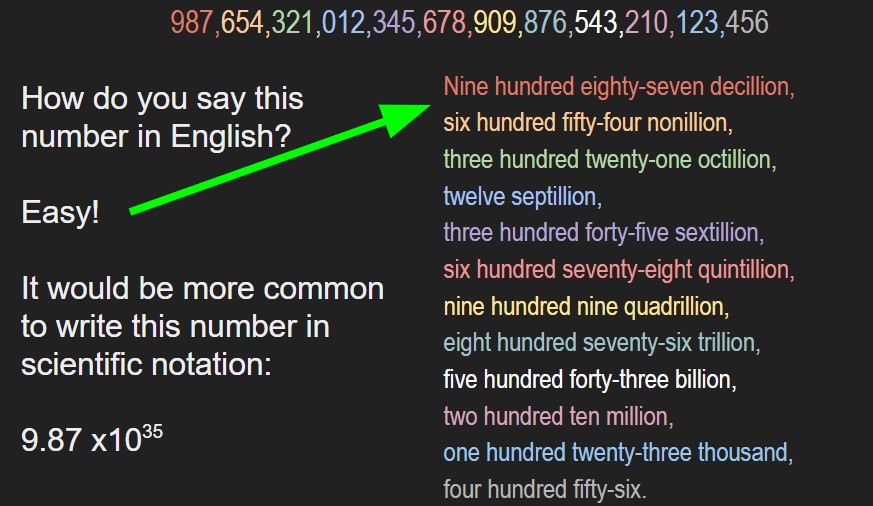
How’d you do? Did you get it right?
And there you go. Now you can read that 36-digit number. This isn’t a terribly useful skill, but since you know the number prefixes now, it’s a cool party trick! Okay, I get it—we probably have very different ideas of what constitutes a “cool party trick.”
I’ve often thought that if we combined the simplicity of small Korean numbers with large numbers in English, we’d have a pretty efficient system! What do you think?
Subscribe to this blog or follow me on Instagram, Threads, Facebook, LinkedIn, or Twitter for more content and updates.