
- My life is shining like a VVS—chit chat ‘bout me
- We all lie—but we all don’t run our English lyrics by native speakers, do we?
- I can’t believe it’s Butter that’s stayed on top of the charts for so long
- Why do I keep harping on about poor English in K-pop lyrics?
- Plastic is rarely fantastic—for the environment or your face
- If it’s worth doing, it’s worth doing right—and other shit old people say
A while ago, I wrote about awkward English K-pop lyrics. Agencies and artists spend time, money, and effort on composing, producing, and choreography. It still baffles me why they don’t confer with a native English speaker about their English K-pop lyrics.
What if I decided to launch my own singing career and decided the way forward was to sing songs I’d written in Korean? I assure you I’d run my lyrics by a native Korean speaker first.

Imagine the outrage if I were to release songs with incorrect, awkward Korean. Would the Korean public welcome me with open arms? Or would I be mocked and shamed? I suspect the latter.
And rightly so. There would be no logical reason not to ask a native Korean speaker to check my lyrics. It would be foolhardy of me to think that all my Korean lyrics would flow naturally.
My life is shining like a VVS—chit chat ‘bout me
The first song on my (s)hitlist this week is here by chance. While getting a haircut a few weeks ago, there was music playing in the background. Though not entirely in English, I could discern English lyrics in the chorus of this K-pop song. I could make them out but had no idea what they meant.
My life’s shining like a VVS, VVS
WTF is a VVS? Pushing 50, I’m not always hip to the latest turns of phrase, so I did some research. It turns out that VVS stands for “Very, Very Slightly included.” In simple English, it’s a diamond with very few flaws, even when viewed under a microscope. So, a top-of-the-line diamond. Okay, now we’re getting somewhere.

Doing more research, I discovered that the term VVS is common in rap. Using an adjective phrase as a noun still feels awkward to me. My life is shining like a “very, very slightly (included)”—but if the cool kids are doing it, so be it. After all, language is constantly changing.
Looking at the other lyrics, which are mainly in Korean, there was one English line that jumped out at me.
Chit chat bout me,
This didn’t seem to fit with the rest of the flow of the song, which at this point is saying:
I was at rock bottom
My mom was an alcoholic
Hungry? Deal with it
Chit chat bout me
Come at me, you coward
“Chit chat ‘bout me” (note the apostrophe I added for the missing “a” in about) means you’re casually talking about me. If I understand the song’s vibe, something stronger is called for. “Talking behind my back“ or “talking shit about me” would appear to fit much better here. But I’m no rap lyricist.
We all lie—but we all don’t run our English K-pop lyrics by native speakers, do we?
I also blogged about using Language Reactor to study language. Following my own advice, I chose a show to study Korean. I looked for a show that involved a general topic (not law, set in a hospital, etc.). I selected a popular show from a few years ago called Sky Castle. It’s the story of wealthy, powerful families that will stop at nothing to see their kids succeed in education and life.
A Korean singer, Ha Jin, sings the English theme song. Choi Jeong-in composed the song and wrote these English K-pop lyrics. Despite hearing the song several times, I couldn’t discern all the lyrics, so I looked them up. The title of the song is “We All Lie.“
It begins:
We all lie
Tell you the truth
Sometimes we laugh and easily lie
Alright, it’s a, it’s faker
The second line is ambiguous. Does it mean “To tell you the truth,” as in “Let me be honest with you…?” Maybe it’s “I tell you the truth,” meaning “Other people lie, but I’m always honest with you.”
The third line is grammatically correct. But putting the adverb “easily” before the verb “lie” feels awkward. The way the line is sung also sounds odd. A Google search for “easily lie” returns about 380,000 hits. The lyrics for this song are actually the first result. In fact, four of the first ten search results are also related to this song. “Lie easily” returns 1.6 million hits, indicating this usage is much more common.

In the final line, why is the article “a” used and then dropped? What is “it” in this sentence? What is faker?
The chorus, on the other hand, flows quite nicely:
Shout it out
What you want for the world
Money, honor, beauty
Everything you want
Play with a mask to hide the truth
Until…
People cheat each other, right?
This phrase is also awkward. If we’re talking about having an affair, you cheat on someone. But as there are no affairs in the show, I don’t think this is the intended usage. Based on the show, I assume the meaning is more along the lines of people will lie and cheat to get ahead in life.
Including “right?” at the end with almost no stress and falling intonation also feels awkward. Perhaps something like, “People lie and cheat and steal,” would’ve worked better. Or maybe a reference to stabbing people in the back could’ve worked.
I can’t believe it’s Butter that’s stayed on top of the charts for so long
Finally, I’m gonna take another swipe at BTS—the current kings of English K-pop lyrics. Earlier, I criticized some suspect lyrics in “Dynamite”. When “Butter” was released two months ago, the pre-chorus immediately made me apoplectic.
Ooh, when I look in the mirror
I’ll melt your heart into two
Huh? Why would you looking in the mirror melt my heart? And how exactly do you melt something into two? You can break something in two. But when something melts, it tends to uniformly get smaller. It doesn’t split down the middle.
BTS even understood this in the Butter trailer. Be warned—this is a 1-hour video of an animated block of butter melting into the shape of a heart. That’s it. One heart. Not broken. It does not melt into two.
BTW, I’m ashamed I’ve contributed to this video’s almost 18 million views while researching this post. I’ve only included it here to prove I’m not lying.
Other lines bothered me.
Gon’ pop like trouble
I’m not sure about you, but for me, it’s actually harder to say “Gon’ pop like trouble” instead of “Gonna pop like trouble.” And what does this line mean? Are they referencing the classic game, Trouble—the one with the dice popper in the middle? If so—why? If not, what does this mean?
Another lyric that left me scratching my head…
Ain’t no other
That can sweep you up like a robber
Why would a robber sweep you up? Sweep you off your feet? Would you be swept up in the excitement? Is this a reference to stealing your heart? I’m very confused.
While the lyrics are more grammatically sound, their nonsensical nature bothers me more. I know, I know, many English songwriters have written their share of bubble gum lyrics. But as I’ve mentioned before, non-native speakers are (unfairly) held to a higher standard. Breaking the rules on purpose is different than making an unintentional mistake.
I intended to blog about this topic last week. But shortly after I started writing, I heard BTS was preparing to release another song. “Permission to Dance” was co-written with Ed Sheeran.
I was curious to see these English K-pop lyrics, knowing that Ed has pushed the rules of grammar in his own lyrics. Examining the lyrics, they hold up grammatically and, on the whole, are more coherent.
But the second verse confuses me.
There’s always something that’s standing in the way
But if you don’t let it faze ya
You’ll know just how to break
Just keep the right vibe, yeah
‘Cause there’s no looking back
There ain’t no one to prove
We don’t got this on lock (Yeah)
Break what? Break what’s standing in the way? Then shouldn’t it be “break it” or “break through?” “There ain’t no one to prove” → “You don’t need to prove anything to anyone?” “We don’t got this” → “We don’t have this” (this gets a pass). “On lock” → This isn’t guaranteed or isn’t under complete control? Or are the last two lines part of the same thought? “No one can prove we don’t have this under control?”
I don’t know how much Ed was involved in writing the lyrics. I don’t know if the band made their own stylistic changes, as they did with “Dynamite.” But one would hope they’d confer with and defer to the expert—the native English speaker.
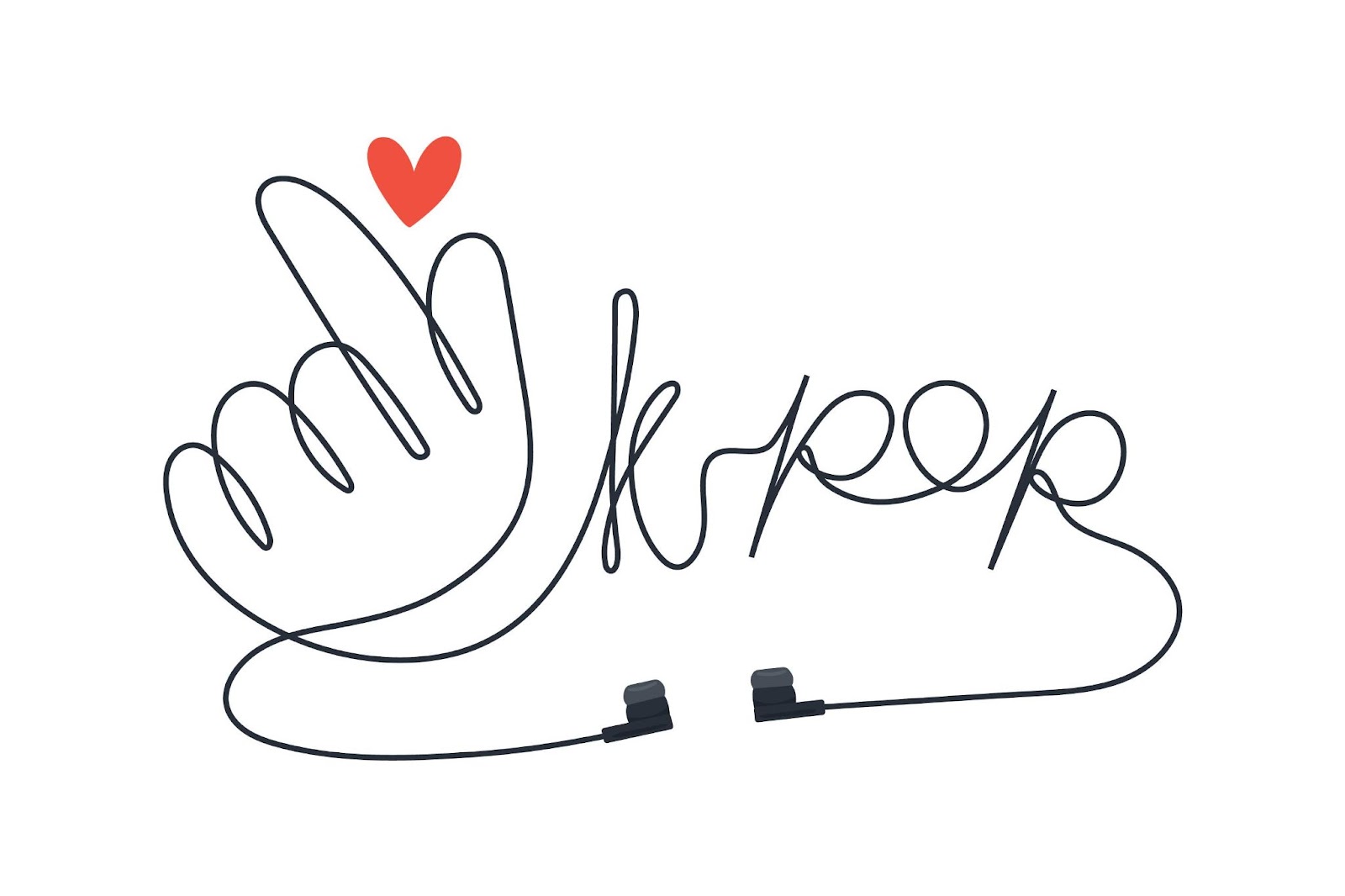
Why do I keep harping on about poor English K-pop lyrics?
I’ll attempt to explain why this bothers me so much. To make my point, I set about looking for examples of English singers using Korean in their songs. As you can imagine, there aren’t many examples. But I did manage to find two.
The first is from a YouTuber called Internet Jules. On her YouTube “About Page,” she says, “I write songs and act ridiculous on and off camera.” In this video, she set herself the challenge of writing a K-pop song. The catch? She doesn’t know any Korean at all.
Here’s what she came up with.
잠시만요 (Wait a moment)
제가 실수를 (My mistake / I made a mistake)
잠시만요 (Wait a moment)
나를 사랑하니 (Do you love me)
중지! (Stop)
내 심장 (My heart)
당신은 그것을 부러 (You break it)Act like im 남사친 (male friend)
And you run away from me
Every single time i blink
To be honest, using a lowercase “i” (with no apostrophe) in “im” and in the final line bothers me more than the Korean. But for my Korean readers, I’m sure the Korean immediately seems awkward. The use of one Korean word in the otherwise English chorus feels forced. Kinda the same way a single English word in a Korean chorus does.
The meaning of the lyrics is clear. But Internet Jules hasn’t always chosen the appropriate words or phrases. If she’d worked with a native Korean speaker, together they could’ve come up with something like:
잠깐
내가 실수를
잠깐
나를 사랑하니?
멈춰
내 가슴
너는 내 가슴을 아프게 해
Not perfect, but a tad more natural, no?

I give Internet Jules full credit for trying—especially with no knowledge of Korean at all. But let’s keep in mind that this was an experiment, a challenge. She didn’t record and release the song. But what if she had?
Then you’d end up with something like this…
Plastic is rarely fantastic—for the environment or your face
Disclaimer—I do not wish to pass any judgement about how this individual identifies with regard to gender or culture. All my comments are based solely on the lyrics themselves.
While looking for examples of Korean used in English songs, I stumbled upon this recently-released song.
I searched for the lyrics online, and even the artist’s Twitter feed directed me to this page. But the Korean lyrics are not written in Korean. They are Romanized Korean but do not follow any standard Romanization rules. As such, they are difficult to discern. Judge for yourself.
(Speaking in an alien language)
Chou neun Oli Eh Oh
Nu na cambo so wa non pogey
Ya reul set ayo kun a man tan
She net coogi irwa go joyo
Note that the bridge is prefaced with the phrase “Speaking in an alien language.” This is the link to the “official” lyrics the artist posted on their own Twitter feed.
I tried a direct transliteration of the Romanization, which produced:
Chou neun Oli Eh Oh
저는 올리이예요 (My name is Oli)
Nu na cambo so wa non pogey
누나 캠 보서 와 넌 포기
Ya reul set ayo kun a man tan
야를 샛 아요 근 아만탄
She net coogi irwa go joyo
시냇 거기 일와 거 쥐요
Aside from the first line, there are only a few possible individual discernable words. But lines 2–4 are pretty much nonsensical.
I was stumped. I asked my teenage son (fluent in Korean) to help me. He informed me it was, indeed, an alien language. Or at least, it wasn’t Korean.
I then attempted to go straight to the source. I reached out to the artist on Twitter and their management company via email. But I’ve heard nothing back. I know my emails were read (I use a tracker), but it would appear they were ignored.

Next, I turned to a large Facebook group, requesting help deciphering the lyrics. I got a few suggestions, noted them all, and then forced asked my son to take another look. He agreed that the second line could be this suggestion from the group:
눈을 감고 소원을 빌기 (Close your eyes and make a wish)
Here are suggestions from the Facebook group for the third line. They are possible but not definitive interpretations:
열을 세아려봐요~ 그러면…
야를 샛 아요 근 아만탄
I only got one suggestion from a helpful Facebook user for the final line:
시내 거기 이르와 가줘요
My point? Ignoring the difficult-to-understand pronunciation, it’s safe to say that the Korean used in this song is awkward—at best. Let’s ignore the troublesome pronunciation. Native and non-native Korean speakers alike have been unable to discern what these lyrics are.
This leads me to believe native Korean speakers were not consulted about these lyrics. Nor were they asked to aid with the pronunciation of said lyrics. The result? Four lines of awkward, almost impossible-to-understand “Korean.”

If it’s worth doing, it’s worth doing right—and other shit old people say
Most English K-pop lyrics aren’t as bad as the two examples of poor Korean lyrics I’ve provided here. But these examples do a decent job of demonstrating my point. If you’re a native Korean speaker, these Korean lyrics likely jump out to you as “awkward.” And that’s precisely how poorly-written English K-pop lyrics jump out at me and other native English speakers.
In both cases, consulting a native speaker would’ve gone a long way to making the lyrics much more natural. Again, I’m not suggesting that song lyrics need to follow strict grammar rules 100% of the time. The first Korean example was pretty much grammatically accurate. But the word choices were definitely awkward.
Rick Beato, a YouTube personality and music professional, commented on “Butter” in May:
Really high production value…Wow! Listen to that!…Listen to that vocal stack. Oh! Autotuned, everything. But so perfect. Just perfectly done. The low end is huge…Straight pop music, but execution is perfect.
He recognizes the quality of the recording and the production. But if you’re going to go to that much effort, why skimp on the lyrics? Why not take the time to consult with a native speaker? Why not ensure the lyrics don’t contain errors or feel awkward?
But maybe I’m just being a grumpy old man. After all, as I write this, Butter has topped the charts for 7 straight weeks. And I don’t hear anyone else complaining about “melt your heart into two.”
But I’m also the type of person who believes if something is worth doing, it’s worth doing right. When/if I launch my K-pop career as a 50-year-old Canadian, I’ll get a native Korean speaker to check my lyrics. I promise. Though shoddily written Korean lyrics will be the least of my hurdles. Trust me.
Share your thoughts with me. Have I got a legitimate gripe? Am I just a grumpy old codger? Do I need to lighten up?
Subscribe to this blog or follow me on Instagram, Threads, Facebook, LinkedIn, or Twitter for more content and updates.
